Case Studies
A selection of projects developed from concept through to execution, showing the thinking, process and outcomes behind the work. Each case study focuses on how ideas are shaped, delivered and refined, combining creativity with strategy and measurable impact.
From Fragmented Communication to a Connected Community
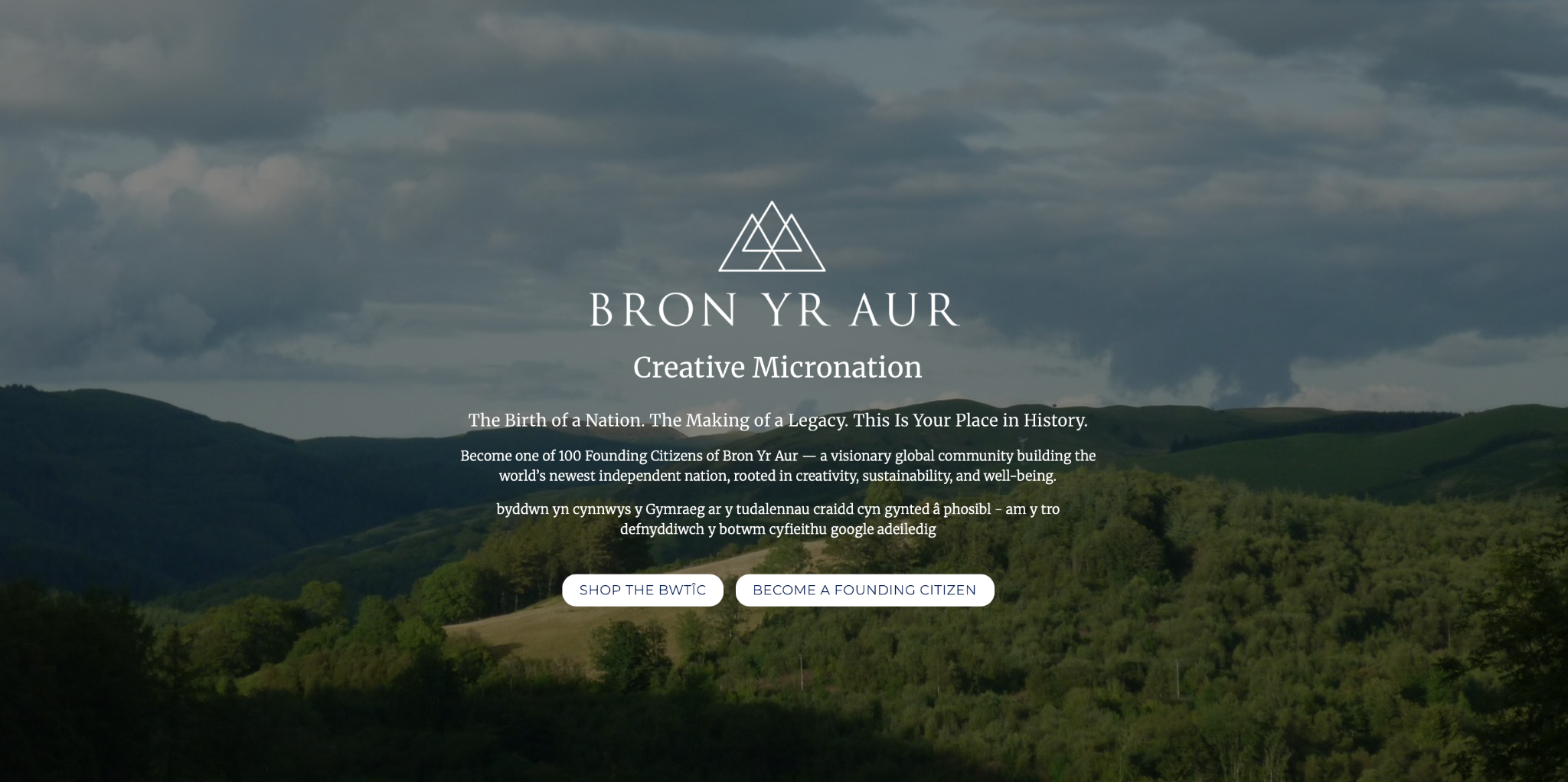
Overview
Bron Yr Aur Micronation is a borderless, global, citizen first cultural community rooted in Wales and growing across continents. It brings together people who want to choose their belonging and take part in building something more creative, sustainable and community led. During my internship as Creative Ambassador (Content & Email Marketing Intern), I worked across content and communication at an early stage of the business. A key part of my role was introducing and developing the brand’s first dedicated newsletter, creating a clearer way to nurture early supporters, communicate the micronation’s purpose, and give wider audiences a meaningful sense of what the community was about.
The Challenge
Bron Yr Aur Micronation had only been established a few months before I started my internship, so communication and content systems were still in their early stages.
At this point, a small number of founders had invested in the vision, but much of the value was still future facing. This created a need to build trust, add substance, and give early supporters a stronger sense of connection through content.
At the same time, email communication was being sent to a wider legacy mailing list connected to Bron Yr Aur Cottage, which already had cultural recognition through its association with Led Zeppelin. This meant communication needed to introduce the micronation to new audiences, re engage existing ones, and nurture early founders simultaneously.
Before I stepped in, communication was inconsistent and unstructured. Emails were either informal updates or long, text heavy messages, with no clear format, little visual hierarchy, and no connection to wider content across social or digital platforms.
My Approach
I introduced the idea of a structured newsletter to replace the previous ad hoc email approach and create a more consistent, intentional communication system.
This became Beyond Borders, a narrative-led newsletter designed to bring together updates, stories, community voices and brand values in one place. The aim was to create something that added value, not just deliver information.
I designed, wrote and launched the first version, establishing the tone and content direction. While the content was strong, it was too long and felt more like a document than a designed experience. It lacked visual hierarchy and did not effectively guide readers towards the brand’s wider content.
I then developed a new plan and led a full redesign using BeeFree. I restructured the newsletter into clear editorial sections, improved readability, and created a stronger visual flow.
I introduced recurring sections, including Micronation Updates, Off Grid Edit, Featured Artist, Ruby’s Recipe, Community Corner, In Conversation and Your New Community, giving the newsletter consistency and a recognisable structure.
I also shifted the newsletter into a more multimedia, cross platform experience. Rather than including everything in one place, I used short editorial introductions and directed readers towards blog content, social posts, videos, podcasts and downloadable PDFs I created.
Alongside this, I used the newsletter to improve audience quality, allowing less engaged subscribers to opt out while building a more aligned and engaged readership over time.
Original Version of Beyond Borders (1st edition)
Key Improvements
- Introduced the brand’s first structured newsletter, replacing inconsistent and text heavy communication
- Designed and launched the first edition, establishing tone, format and editorial direction
- Led a full redesign using BeeFree to improve layout, readability and user experience
- Created recurring sections to build consistency, familiarity and a stronger brand identity
- Shifted the newsletter into a curated editorial product focused on storytelling and community
- My journalism background allowed me to conduct high-quality interviews that added value and social proof
- Integrated cross platform links to social content, blogs, videos, podcasts and downloadable resources
- Used the newsletter to both nurture early founders and introduce the micronation to wider audiences
- Improved audience quality by encouraging a more engaged and relevant readership
Updated Version of Beyond Borders (2nd edition)
The Results
- Achieved an open rate of over 60% on the first Beyond Borders newsletter
- Created a more valuable and engaging email experience, giving readers a clearer understanding of the micronation
- Improved communication with early founders by adding depth, storytelling and community context
- Introduced the micronation more effectively to legacy and less engaged audiences
- Increased traffic to social content, blog posts and downloadable resources
- Received direct positive feedback and personal messages from members of the founding community
- Strengthened list (lead) quality by allowing uninterested subscribers to unsubscribe, resulting in a more engaged audience
- Built greater trust and credibility through consistent, thoughtful and well structured communication
Key Learning
This project reinforced that effective communication is not about producing more content, but about creating more value. By introducing structure, clarity and storytelling, I was able to transform fragmented communication into a more engaging system that nurtured early supporters, introduced new audiences, and helped define how the brand presents itself in its formative stages.
Passion Project: Politics on the Pavement
Overview
Politics on the Pavement is a self-initiated video journalism project exploring how people in Manchester respond to political topics in everyday settings.
I created the project outside of my academic work in my first week of my multimedia journalism master's. Created with Aleks Milwicz to develop our skills in interviewing, filming and editing, while testing how political content can be made more engaging for social media audiences.
Listen below for a short (and frank) explainer about the Politics on the Pavement project
Context
The project was intentionally experimental. Rather than aiming for a polished final product, the focus was on learning through doing, working in real world environments and understanding what works and what doesn’t when creating short form video journalism.
Approach
Aleks Milwicz and I planned and conducted street interviews across Manchester, asking members of the public questions around political topics. The aim was to capture natural, unscripted responses while maintaining a neutral interviewing style. We filmed and edited the footage into short form videos for platforms like TikTok and Instagram, experimenting with pacing, structure and format.
What Didn't Work
Some of the interview questions were too leading or overly complex, which reduced the clarity of responses. I also over edited the footage, removing natural pauses and moments, which made the content feel less authentic. Not all of the recorded material was engaging, and I initially included too much footage rather than being selective. We also used poor audio equipment and filmed in the wrong orientation, which affected the overall quality of the final output.
Key Learning
- This project was valuable because it made the gaps in my early journalistic approach very clear
- I learnt that strong vox-pop interviews rely on simple, open questions rather than overcomplicated ones
- I understood the importance of staying neutral and not influencing responses
- I realised that authenticity matters more than polish, and that over editing can reduce credibility
- I also learnt to be more selective, focusing on stronger clips rather than trying to use everything I filmed
- Finally, I developed confidence in approaching the public and working in unpredictable, real world environments
Outcome
This project was created in the first week of my Journalism MA, at a point where I initially assumed this style of content would be relatively straightforward to produce. Through the process, it quickly became clear that effective street interviews and short form journalism require a high level of skill, from asking the right questions to editing in a way that maintains authenticity.
This early experience gave me a clear understanding of where I needed to improve, and since then I have developed those skills further through continued practice and learning.